
The Courage to See

Sermon for the Third Sunday in Lent: John 4:5-42
There’s a phenomenon called the observer effect which basically says the mere act of observing something changes it. Take the double-slit experiment. They shoot a single ray of light at a panel with two little windows, or slits, in it. Most of the light’s blocked by the panel, but some slips through. And the light that makes it through shines on something else, another panel, special sensors, whatever. (My apologies to all the actual scientists in the room.) This is where it gets weird. Sometimes the light coming through acts like a particle, sometimes like a wave. Sometimes it acts exactly as expected, sometimes unpredictably. There’s a lot of theories attempting to explain why, but suffice it to say, the experiment shows that the simple act of observation changes how the light behaves. Why remains uncertain, but that it does is well-documented. Anyone who’s ever been a teenager knows this holds with human behavior, too. When I was about 13 or 14, the worst thing that could happen to me was to be seen. I wanted desperately to fade into walls or hide behind my backpack or skulk as far away from family as possible so that no one could tell I went with them. Being seen wasn’t just embarrassing, it set my ears on fire and sent cutting jabs out of my mouth. If I couldn’t hide behind physical barriers, I’d hide behind caricatures and masks and keep certain observers at a distance. If I didn’t know I was being seen, I was more comfortable, but as soon as I knew eyes were on me, I changed. And sometimes even just imagined eyes were enough. Let’s try a different one. How many of y’all drive exactly the same as you always do when you see a state trooper in your rearview mirror? That’s what I thought. When we know we’re being observed, we act differently.
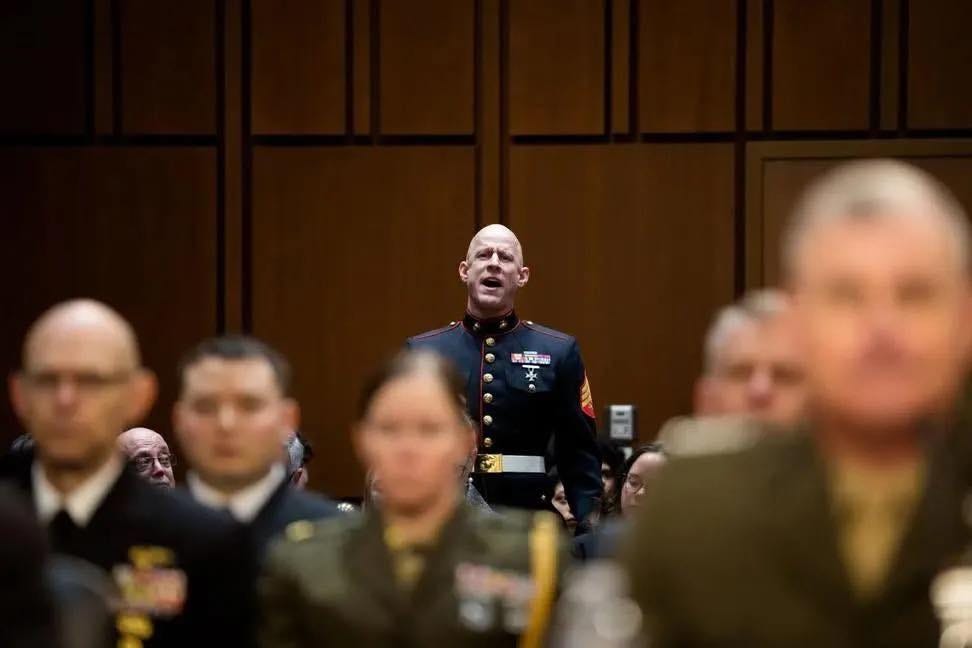
Last Wednesday, at a hearing of the Senate Armed Services Committee, a Marine Corps veteran interrupted the proceedings in protest over US policies in the Middle East, including the officially undeclared but very much underway war in Iran. Capitol Police were in the process of removing him when things got messy. A US Senator added his strength to the effort, and in the process of trying to force the veteran out of the room, the Senator broke the veteran’s arm. Now, I don’t think he did it on purpose; but how he “assisted” was, at best, careless and probably unnecessary. As disturbing as that was, it kinda gets worse, but in a different way. See, after that part played out, the person filming turned the phone to film the rest of the room. Other than the orders from the Capitol Police and the outcry of a couple of regular people, it’s silent. The politicians on the dais stayed quiet. Rows of military officials and consultants sat with their backs to the scene. A handful of aides speckled the room. And no one moved. These are THE people -- politicians and military leaders -- who’re supposed to take care of veterans, and none of them moved. They didn’t even turn their heads. It was spooky! I did some digging to see if this video’s fake ‘cause surely something so dystopian couldn’t be real. From what I can tell, though, that is how it happened. They couldn’t even look. Maybe they didn’t want to see or were afraid of what might happen if they reacted or worried they might get in trouble just for witnessing, but for whatever reason, they wouldn’t look. There’s no missing the commotion on this one; a man had his arm broken in a very public place in a violent manner, and not one of them looked. That took real effort. Aides hid their gaze and pretended to scribble down notes. Generals kept their eyes locked straight ahead. The only person who seemed concerned was the one holding the camera. Were it not for her, I wouldn’t have seen this. Many wouldn’t’ve. And if it hadn’t been filmed, I wonder if the story would’ve come out at all. This wasn’t lethal like Ruben or Renee or Alex or Kevin, but it highlights the great power of observers. It’s wild to realize that these are the better outcomes, that the presence of phones and eyes dampens the reality of what would happen were no one there to see. And if you’ve studied history even briefly, you’ve got a sense of what happens when no one’s there to see.
Observation changes things. When Jesus invited people to follow him, he regularly said, “Come and see.” Come and see what he’s about, what he does, who he serves, and who he loves. Seeing Jesus in action is compelling, and it changes even the observer’s heart. There at the well, Jesus talked with someone he shouldn’t. There’s a wealth of reasons why, but for today, let’s keep it simple. Neither one of them “should’ve” had contact with the other, but here we are, beside a life-giving well in the middle of a desert. And it plays out exactly as you’d expect. There’s some theological sparring, he promises new life, and she’s convinced he’s the real deal. She runs into town, tells everybody what’s going on, and invites ‘em all to come with her and see. “Come and see,” she says. This is not new. The Hebrews needed to see that God was with them. Paul needed to see before he converted. That woman needed to see Jesus at the well, and the people she told needed to see for themselves. They needed to look, and she showed them where.
Do you know what the word “repent” means? It means “to turn.” Metaphorically (and sometimes literally) turning your face from the wrong path and toward a better one. Our baptisms act this out. The candidate says they repent and renounce all kinds of evils, including “the evil powers of this world which corrupt and destroy the creatures of God” and then promises “to turn to Jesus.” In the old days, the candidate literally turned to face the east right then, physically embodying the change they promised to make, the change that came simply by turning to face a new direction, turning to see. That moment with the veteran wasn’t the only time we’ve observed the refusal to turn and see. And I’m sure it won’t be the last ‘cause so long as we don’t see, so long as we don’t look, nothing is threatened, and if nothing is threatened, nothing will change. Y’all, that’s the ostrich’s approach to justice - no offense to ostriches intended.
Here’s the thing. That video is haunting. It’s certainly graphic enough to cause visceral discomfort. But that scene of people frozen in place, refusing to look -- believe it or not, that refusal gives me hope. Ya see, I don’t think those people didn’t look because they didn’t care. I think they didn’t look because they’re afraid. Of what, I couldn’t say exactly, but I have a theory. I think they’re afraid of looking because if they look, they can’t help but see, and if they see, they can’t help but change. Or if we look, if we see, they can’t help but be changed. The beginning of the Gospel of John says Jesus’ light shines in the darkness and the darkness comprehends it not. Evil can manage a lot of damage, but where it lacks power, where it’s at its weakest is out in the open, exposed and visible and tenuous and, above all, seen. Look at how much evidence is hidden, how much is redacted, how much is suppressed. Even the proliferation of AI videos and images plays into this; it draws our eyes elsewhere, muddies our ability to trust what we’ve seen, hides true evil where we expect for light to shine.
Observation must be a threat for all the ways they try to turn the lights back down. There wouldn’t be such an effort to shut our eyes if our vision wasn’t already a problem for them. If the simple act of observation is enough to change this system, if just a few heads turning to see is enough to threaten their security, then this system’s nowhere near as robust or inevitable as they’d have us believe. Who would’ve thought that just turning your head could take down an empire? Evil thrives unseen. But evil is weaker, more pitiable, than it would have us believe. Seeing that changes something in us, but our observation of evil changes it, too. It recoils, pulls back from where it’s exposed, uses all the tools at its disposal to keep us from looking in the first place. ‘Cause if we don’t look, we can’t see, and if we can’t see, we’ll never know where evil is to stop it. So it’s up to us to look. Have the courage to turn our heads. Have the courage to repent, even. Open our eyes to look. Observe, especially where observation’s discouraged. Or, to borrow a phrase, come and see.
This is beautiful, Brooks.
I didn't know about that Arm Services Hearing and the veteran that protested. No one looked? Incredible. Did it make the traditional news. I don't think so, but with chaos at hand it would be easy to miss. The old hymn says it well: "Open my eyes that I might see..." A bit harder to do, but we must. Thanks, Brooks. You are both seen and heard with an open heart. Need to watch to help, watch to protect, watch to befriend. 😔🙏