
Accounting for Hope

Sermon for the Sixth Sunday of Easter: I Peter 3:13-22 & John 14:15-21
Every so often, a line from those readings sticks out in a way I’ve never noticed before. This week it’s I Peter: “Always be ready to make your defense to anyone who demands from you an accounting for the hope that is in you.” An accounting for the hope that is in me? Doesn’t that assume there is hope within me? I know I should have hope that all things’ll be made right, goodness will prevail, God’s in control, etc. etc. etc. I may not always be a good Christian, but I’m always human, and humans can have a hard time with hope. There’s so much that keeps us up at night, turns our hairs white, and cuts into our life spans. But Christian tradition stakes a particular claim to hope. Hope that all shall be well, and all shall be well, and all manner of things shall be well…for the universe, sure, for our species, maybe, but not so surely for me as an individual. That’s pretty scary and isn’t exactly the most hope-breeding thought.
But there’s more going with Christian hope here than just “what’s in it for me.” I mean, yes, there’s the peace which passes understanding, the love of God, the meaning everyday life gets imbued with, that sort of stuff’s personally satisfying and enriching, but the real beauty of this Body is what it does in relationship with God and the world. God’s bigger than my interests, and Christianity’s bigger than me. And the great Body of Christ of which each of us are part, it’s bigger than the individuals that make it. We’re part of something bigger. And this big, ancient, new Body intended to serve God and serve neighbor, it’s at its best when each of us are, too. But as just one part, what can any one person do to make a difference? Our Bible stories are chock full of one person doing stuff for good or for ill that makes a difference. Jesus is just one man (albeit a rather significant one). Pilate’s just one man. So were Cain, and Adam, and Paul who blamed Adam for the entire fallen state of humanity. Sarah made a difference as just one woman. So did Mary and Elizabeth and Deborah.
But those pretty significant protagonists (and antagonists) are immortalized in scripture. The big names make for wonderful stories, but when it comes down to our big world and our great Body, most of us aren’t listed that high in the playbill. I’m not. Most of us aren’t. We’re just people. Or, to use the language of Paul, not all of us are eyes or heads or hands. Some of us are gall bladders and tailbones and pinky toenails. But small as we may be, insignificant as our actions may feel, we’re still part of a Body that does great things. Our history’s smeared with main characters with miraculous stories, significant figures whose witness inspires us with that main character energy and a whole lot more influence than most of us’ll ever muster. But extraordinary witness from extraordinary people isn’t all that surprising. Inspiring, perhaps, but we expect the greats to be great.
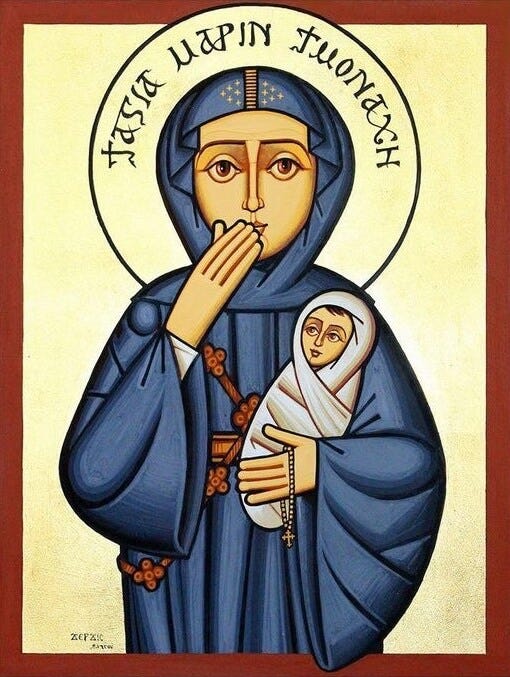
I’m more interested in the smaller saints of our calendar. (Saints in the Episcopal Church, by the way, aren’t perfect people. They’re regular people that responded to their world with extraordinary faith.) We don’t expect -- or we’re less likely to expect -- the mundane to be special. And y’all, we’ve got a whole calendar of those kinds of mundane saints! There’s Emily Marlbone Morgan, a layperson who advocated for the working poor, especially working women, and helped them take vacations that otherwise would’ve been out of reach: saint of the church. Or James Solomon Russell, a once enslaved man who earned an education, became a priest, teacher, and church planter: saint of the church. Or Marina the Monk, born a woman probably in the 5th Century AD, who lived as a faithful male monk with a male name and a male haircut: saint of the church. Much to the chagrin of Thomas Cranmer, there’s almost as many of these saints as there are days in the year. Our Body cares what everyday people get up to, people who fix what needs fixing or approach their regular life like it’s the sacred calling it is. One person may not change the whole world, but one person can affect part of it. We are those everyday saints. We may feel too small to matter or make a difference, but in this Body, we’re no less important than the tiniest bit of salt keeping cells in equilibrium, no less helpful than lipids surrounding nerve fibers, no less sacred than rods and cones lining the back of an eye. Millions of tiny parts make up this great Body, a network within a network not just alive but thriving, resisting, meeting horrors and joys with grace and, yes, even with hope, and doing it together.
I know this may sound like a different kind of sermon than what I’ve been preaching lately, but it’s not, not really. We’ve watched as one man’s made a lot of difference. If you’re anything like me, when that late night doomscroll takes over, I feel smaller and smaller as the enormities of this era wash over me. Intellectually, I know it’s not on me. Spiritually, I know it’s not on me, either. But still, despair works its way in, and if I’m not careful, instead of trying to figure out how to be helpful, I question if anything I would do would even matter. And then I remember a forgettable saint, or one of you asks what you can do, and I’m jolted out of my wallow and reminded that, oh yeah, I’m supposed to help instill some hope or something, but where exactly am I supposed to find it to show you? Turns out, it’s in the same places you find hope. In lovely people helping their little corners, aware of but not consumed by great evils. My body can’t do much against those great evils, but our Body can.
Jesus says, “if you love me, you will keep my commandments.” He doesn’t say, “and that’ll fix everything.” We gotta trust that other parts of this Body are keeping his commandments, too. Lungs breathing without thought, feet taking us where we’re needed most, hands serving, hearts pumping, mitochondria powerhousing. All these quotidian saints working together’ve got great potential to change the world a corner at a time, and maybe even instill some hope while we’re at it. And so many ache for that hope right now. I don’t know how much we can give them, but I know every last one of us living with that ember of hope still burning in spite of all the reasons it shouldn’t, I know that kind of stubborn hope is contagious. The litany of headlines isn’t a reason to let that ember suffocate; that litany’s a signpost pointing us to those who need our hope the most.
What a relief it is to know we don’t have to save the world. But we do have to hold onto hope. That hope’ll carry our small stories to places and people we can’t imagine, and those stories and the hope they carry may just be the boost one of those main characters needs. Or maybe one of you will be that main character, that hero or heroine, supported by forgettable, inconsequential, world-shattering witnesses riding the pews. Maybe. So don’t lose hope. Get angry, feel your heart break, stand for mercy and justice, but don’t lose hope.
The passage from John14: 15 "If you love me, you will obey what I command", really sounded like an order and challenge to me. Ouch! Challenge.? Then my pastor said, " No, not a challenge but a gift." A love filled with hope because we are not alone. Each small act of kindness builds for a better world. Well~ this gift still feels a bit like a challenge. My Hope faded a bit last week. But thinking about the small acts of hope and love I have been witnessing recently in very public places does build hope. Small acts al together are powerful. Thanks, Rev. Cato, for this reminder.
*Future Thom here, sorry this was a longer comment than I anticipated 🤦♂️. Apologies for the novella.*
I found so much of 1 Peter calling to us today in our, very much, fallen world. In many ways, it seems to be a direct challenge to us to overcome the "Bystander Effect."
Which, to provide for ease, is the effect described in social psychology that, "when the presence of others discourages an individual from intervening in an emergency situation, against a bully, or during an assault or other crime. The greater the number of bystanders, the less likely it is for any one of them to provide help to a person in distress. People are more likely to take action in a crisis when there are few or no other witnesses present." (per Psychology Today)
In context of the reading this week, this is 1 Peter 3:14-17:
"But even if you do suffer for doing what is right, you are blessed. Do not fear what they fear, and do not be intimidated, but in your hearts sanctify Christ as Lord. Always be ready to make your defense to anyone who demands from you an accounting for the hope that is in you;
yet do it with gentleness and reverence. Keep your conscience clear, so that, when you are maligned, those who abuse you for your good conduct in Christ may be put to shame. For it is better to suffer for doing good, if suffering should be God’s will, than to suffer for doing evil."
My parents always emphasized this growing up, though not in any theological sense. But still that, you strive to do the right thing no matter what. Which aligns with 1 Peter.
In a way, that gives me hope. The hope that, in the end, goodness and righteousness will prevail. As Christ prevails through his suffering and death on the Cross.
The hymn I come back to that gives me so much hope these days is "Abide With Me". That through the darkness, the shadows, and through the moment of our death in this life, that we are never alone when we're with Christ.